
The transport of dangerous goods by road is one of the most tightly regulated activities within the logistics and industrial sectors. This is not without reason. incidents involving dangerous goods can lead to severe consequences, including environmental damage, injuries, fatalities, and large-scale economic disruption. To minimize these risks and ensure a harmonized level of safety across borders, countries have adopted the ADR, an international agreement that governs the carriage of dangerous goods by road.
Within this framework, one of the most important and often underestimated obligations is the requirement for employees to follow adr awareness training under chapter 1.3. This obligation applies not only to drivers, but also to employees who are involved in the preparation, handling, and processing of dangerous goods. This includes packers, fillers, loaders, unloaders, consignors and any staff member whose work has an impact on the safe transport of dangerous goods.
This article provides a complete and detailed explanation of these obligations, including their legal basis, their applicability even under the 1000 points exemption. The countries that fall under the adr agreement, and how different countries have embedded adr into their national legislation.
What is Adr and why it matters
The adr agreement was developed under the supervision of the United Nations Economic Commission for Europe and has been in force since 1968. Over the years, it has evolved into a comprehensive and highly detailed regulatory framework that is updated every two years to reflect new insights, technologies and risks.
Adr does not only deal with the transport itself, but with the entire chain surrounding dangerous goods. It defines how substances must be classified, how they must be packaged, how they must be labeled, and how they must be documented. It also assigns clear responsibilities to all parties involved in the chain.
This means that companies cannot limit their compliance efforts to transport alone. Every action that takes place before the transport begins, and even after it ends, can fall under the scope of adr. Employees who prepare shipments, fill containers, load vehicles or draft transport documents are all part of the regulated process.
The legal obligation of adr 1.3 training
Adr chapter 1.3 forms the legal basis for training requirements. It states that all persons whose duties concern the carriage of dangerous goods must be trained in accordance with their responsibilities. This is a broad and far-reaching obligation. It does not distinguish between operational roles and administrative roles. As long as an employee’s work influences the transport of dangerous goods, training is required.
This training is often referred to as adr awareness training. The term awareness is somewhat misleading, as the requirement goes beyond simple awareness. Employees must have sufficient knowledge to perform their tasks safely and in compliance with adr. The training must be tailored to the specific role of the employee and must be provided before the employee carries out relevant tasks.
Companies are also required to keep records of this training. In the event of an inspection or incident, authorities must be able to verify that employees have been adequately trained. This makes adr 1.3 not only a safety requirement, but also a documentation and compliance obligation.
Why the obligation applies to packers, fillers, loaders, unloaders and consignors
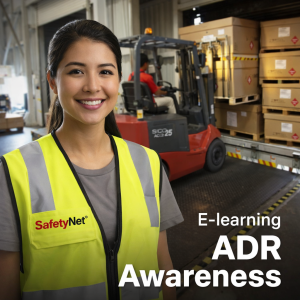 A common misconception is that adr obligations mainly apply to drivers. In reality, the majority of errors and incidents occur before the transport even starts. incorrect packaging, wrong labeling, incompatible loading or incomplete documentation can all lead to dangerous situations on the road.
This is why adr explicitly includes a wide range of roles within its scope. Packers must ensure that dangerous goods are correctly packed and labeled. Fillers must ensure that tanks and containers are filled safely and within permitted limits. Loaders must take into account segregation rules and load securing. Unloaders must handle goods safely upon arrival. Consignors must ensure that all documentation and classification are correct before goods are handed over for transport.
Each of these roles has a direct influence on safety. Therefore, each of these roles requires proper training under adr 1.3. It is not sufficient for a company to rely on the knowledge of a single specialist or advisor. The obligation applies to all employees involved.
Adr awareness training and the 1000 points exemption
One of the most misunderstood aspects of adr is the so-called 1000 points exemption, often referred to as the small load exemption. This exemption allows certain transports of limited quantities of dangerous goods to be carried out with reduced requirements. For example, vehicles under this threshold do not require orange plates and drivers may not need a full adr driver certificate.
However, this exemption does not remove the obligation for training. Adr chapter 1.3 applies independently of the quantity of dangerous goods being transported. even when a company operates entirely under the 1000 points threshold, Employees involved in the process must still be trained.
This is a important point for your compliance. Many companies incorrectly assume that operating below the threshold means that adr does not apply. In reality, the exemption only reduces certain operational requirements, but does not eliminate the need for awareness and competence.
From a risk perspective, this makes complete sense. Even small quantities of dangerous goods can pose significant risks if handled incorrectly. Improper labeling or packaging can still lead to incidents, regardless of the quantity involved.
Countries that are party to the Adr agreement
The adr agreement has been widely adopted and currently includes more than 50 contracting parties. These countries span europe, parts of asia and even North Africa. The broad adoption of adr ensures that dangerous goods can be transported across borders under a consistent set of rules.
Countries that are party to adr include, among others, the Netherlands, Belgium, Germany, France, Italy, Spain, Portugal, Denmark, Sweden, Norway, Finland, Poland, Czech republic, Slovakia, Hungary, Austria, Switzerland, Ireland, the United kingdom, and many more. outside the european union, countries such as Turkey, Ukraine, Morocco, Kazakhstan and others have also adopted adr.
This wide geographical coverage makes adr one of the most important regulatory frameworks in international logistics. companies operating in multiple countries benefit from a harmonized system, but they must also ensure that they comply with local implementation laws.
National implementation of Adr legislation
Although Adr is an international agreement, it is enforced through national legislation. Each country incorporates Adr into its own legal system, often with additional provisions or enforcement mechanisms.
In the Netherlands, the Adr is implemented through the “Regeling vervoer over land van gevaarlijke stoffen” and the broader framework of the Wet vervoer gevaarlijke stoffen. These laws make the Adr directly applicable and enforceable.
In germany, the Adr is embedded in the “Gefahrgutverordnung straße, eisenbahn und binnenschifffahrt”, commonly referred to as ggvseb. This regulation provides detailed rules for the transport of dangerous goods and aligns closely with adr.
In France, the Adr is implemented through the “Arrêté tmd”, which governs the transport of marchandises dangereuses. This decree ensures that adr provisions are applied within the french legal system.
In the United kingdom, the Adr is implemented through the “Carriage of dangerous goods and use of transportable pressure equipment regulations”. Even after brexit, the uk continues to apply Adr principles.
In Belgium, the Adr is incorporated into national law through royal decrees concerning the transport of dangerous goods by road. These decrees align Belgian law with adr requirements.
In Italy, the Adr is implemented through legislative decrees that integrate international transport agreements into national law, often referred to in the context of “Trasporto merci pericolose”.
in spain, adr is incorporated through the “real decreto sobre el transporte de mercancías peligrosas por carretera”, which governs the national application of adr.
in denmark, adr is implemented via the “bekendtgørelse om vejtransport af farligt gods”, which regulates road transport of dangerous goods.
in sweden, adr is enforced through the regulations of the swedish civil contingencies agency, known as msb, under the framework of “transport av farligt gods”.
in poland, adr is implemented through the “ustawa o przewozie towarów niebezpiecznych”, which governs the carriage of dangerous goods.
in hungary, adr is incorporated through national decrees related to the transport of dangerous goods, often referred to under the broader framework of “veszélyes áruk szállítása”.
these examples demonstrate that while adr provides a harmonized framework, compliance is ultimately enforced at the national level. companies must therefore be aware not only of adr itself, but also of how it is applied in the countries where they operate.
Practical implications for companies
For companies involved in the handling or transport of dangerous goods, the implications of adr 1.3 are significant. Compliance is not a one-time effort, but an ongoing process that requires continuous attention.
Employees must be trained before they start working with dangerous goods. This training must be tailored to their specific tasks and responsibilities. Companies must maintain records of training and ensure that knowledge is kept up to date.
From a management perspective, adr 1.3 training is also a risk management tool. Well-trained employees are less likely to make errors, and when they do encounter unusual situations, they are better equipped to respond appropriately.
In addition, training plays a key role in demonstrating compliance to authorities, clients and insurers. In many industries, the ability to show that employees are properly trained is a prerequisite for doing business.
Start your adr 1.3 training now!
Efficient compliance through e-learning
In today’s international and fast-paced business environment, traditional classroom training is not always practical. Companies operate across multiple locations, employees work in shifts, and time is often limited.
This is where e-learning offers a powerful solution. Online training platforms allow employees to follow adr awareness training at their own pace, in their own language, and at a time that suits their schedule.
Platforms such as Adr-online.eu provide structured and compliant adr 1.3 courses that cover all relevant topics. these courses are designed to be practical, accessible and aligned with current adr requirements. upon successful completion, participants receive a certificate that serves as proof of training.
For companies, this means:
- Consistent training across all locations
- Reduced administrative burden
- Immediate availability of training
- Easy documentation and record keeping
Conclusion
Adr awareness 1.3 training is not an optional extra. It is a legal obligation that applies to a wide range of roles within the dangerous goods supply chain. Packers, fillers, loaders, unloaders and consignors all have a direct impact on safety and must therefore be properly trained.
This obligation applies regardless of the quantity of dangerous goods being transported. Even under the 1000 points exemption, training remains mandatory. companies that fail to recognize this risk not only non-compliance, but also increased exposure to incidents and liability.
With the Adr being implemented in more than 50 countries and enforced through national legislation, the need for a structured and reliable approach to training is clear. E-learning solutions such as Adr-online.eu provide an efficient and effective way to meet these requirements and ensure that employees are properly prepared.
Investing in Adr awareness training is not just about compliance. it is about safety, professionalism and responsibility within the dangerous goods chain.